
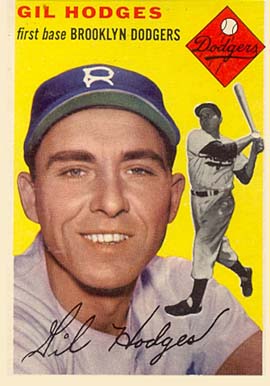
Gil Hodges
“Not getting booed at Ebbets Field was an amazing thing. Those fans knew their baseball, and Gil was the only player I can remember whom the fans never, I mean never, booed.”1 — Clem Labine
“… epitomizes the courage, sportsmanship and integrity of America’s favorite pastime.” — back of a 1966 Topps baseball card
“Gil Hodges is a Hall of Fame man.”2 — Roy Campanella
“If you had a son, it would be a great thing to have him grow up to be just like Gil Hodges.”3 — Pee Wee Reese
“Gil Hodges was the most important person in my career. Above all, he taught me how to be a professional.”4 — Tom Seaver
“He [Hodges] was such a noble character in so many respects that I believe Gil to have been one of the finest men I met in sports or out if it.” — Arthur Daley, New York Times
Gil Hodges was born Gilbert Ray Hodge on April 4, 1924, at Princeton, Indiana, in the state’s southwestern corner. The origin of the discrepancy between his birth name of Hodge and the name by which he became well-known is unclear; however, the family name was Hodges at least by the time of the 1930 U.S. census. Gil’s parents were Irene K. (née Horstmeyer) and Charles P. Hodges. When Gil was 7 years old, the family, including older brother, Robert, and younger sister, Marjorie, moved 30 miles north to Petersburg. Big Charlie, as Gil’s father was known, did not want his two sons to work in the coal mines as he did. (Big Charlie lost an eye and some toes in various mining accidents and died of a heart embolism in 1957.)
Charles Hodges taught his sons how to play sports, and Gil was a four-sport athlete at Petersburg High School. He ran track and played baseball, basketball, and football, earning a combined seven varsity letters. In 1941, like his brother before him, Hodges was offered a Class-D contract by the Detroit Tigers, but he declined it and instead enrolled at St. Joseph’s College on an athletic scholarship. St. Joseph’s, located 100 miles north of Indianapolis, had a well-regarded physical education program, and Hodges had designs on a college coaching career. Gil played baseball and basketball for the Pumas and was a member of the Marines ROTC.
After his sophomore year, he was offered a contract by local sporting goods storeowner and part-time Dodgers scout Stanley Feezle. The lure of playing in the major Leagues was too much this time, and Hodges left St. Joseph’s and signed with Brooklyn, who then sent him to Olean, New York. He worked out with the Class-D Oilers but did not appear in a game.
Brooklyn called up the 19-year-old Hodges late in the 1943 season. He made his debut at Crosley Field on October 3, the Dodgers’ last game of the year. Facing Cincinnati’s Johnny Vander Meer, Gil went 0-for-2 at the plate and made two costly errors at third base. Eleven days later, he entered the Marine Corps and was sent to Hawaii, first to Pearl Harbor and later Kauai. Hodges served as a gunner for the 16th Anti-Aircraft Battalion. From Hawaii he went to Tinian, the sister island of Saipan in the South Pacific. In April 1945, Sergeant Hodges, now assigned to his battalion’s operations and intelligence section, landed on Okinawa with the assault troops and was subsequently awarded the Bronze Star. Don Hoak, a future Dodgers teammate, said, “We kept hearing stories about this big guy from Indiana who killed [Japanese soldiers] with his bare hands.”5 Discharged in February 1946, Hodges went to spring training with Brooklyn.
The solidly built Hodges stood a half-inch over 6-foot-1, and weighed 200 pounds. He batted and threw right-handed, and was considered big for a baseball player of that era. However, Hodges was a gentle giant, often playing the role of peacemaker during on-field brawls. His hands were so large that teammate Pee Wee Reese once remarked that he could have played first base barehanded but wore a mitt because it was fashionable.
Dodgers president Branch Rickey sent the now 22-year-old Hodges to the Newport News (Virginia) Dodgers, the club’s entry in the Class-B Piedmont League, where he was converted from infielder to catcher. Gil played 129 games, hitting .278 with eight home runs for Newport News. For his efforts, Hodges was named to the all-league team. He went to the historic and tumultuous Dodgers 1947 spring training and made the team. He was the second-string catcher but played just 24 games behind the plate as the backup to Bruce Edwards.
On May 17 at Forbes Field, Hodges, batting for pitcher Harry Taylor, singled off Pittsburgh’s Fritz Ostermueller for his first major-league hit. Gil hit his first major-league home run on June 18, at Chicago’s Wrigley Field. His blast came in the seventh inning against Cubs starter Hank Borowy, and broke a 3–3 tie.
Hodges appeared in 28 games overall in 1947, hitting an anemic .156. He clearly needed more playing time, but he was not going to get it behind the plate. With Roy Campanella on the way to take over for Edwards, another position change for Hodges was in order. The next spring Dodgers manager Leo Durocher “put a first baseman’s glove on our other rookie catcher, Gil Hodges. . . Three days later,” Durocher said, “I’m looking at the best first baseman I’d seen since Dolph Camilli.”6
In 1948 Hodges played 96 games at first base, but he was the catcher in 38 games, as well. With 13 errors at first, his fielding percentage was .986, the only year he played regularly that he fielded under .990. In addition, he contributed 11 home runs and 70 runs batted in for the third-place Dodgers. He would not drive in fewer than 100 runs over the next seven seasons, nor would the Dodgers finish lower than second place over the next eight campaigns.
On December 26, 1948 Hodges married the former Joan Lombardi, a Brooklyn girl from the Bay Ridge section. The Hodges couple made a permanent home in Brooklyn, one of the few Dodgers to do so, and raised four children, Gil Jr. (who would spend some time as a player in the New York Mets minor league system), Irene, Cynthia, and Barbara. (Joan Hodges still lives in that same house in Brooklyn.) This no doubt made Gil “one of them” in the eyes of the fans. Walter O’Malley, the Dodgers’ owner, stated, “If I had sold or traded Hodges, the Brooklyn fans would hang me, burn me, and tear me to pieces.”7 Lastly, the very busy Hodges used the GI Bill to earn his degree at Oakland City College in Indiana during the 1947 and 1948 offseasons.
By 1949 the Brooklyn Dodgers were poised for the most productive period in the franchise’s history. The fabled lineup was in place: Roy Campanella behind the plate, Hodges at first, Jackie Robinson at second, Pee Wee Reese at short, Billy Cox at third, Duke Snider in center, and Carl Furillo in right with a rotating cast in left. The team did not disappoint; Brooklyn won the National League pennant, edging the St. Louis Cardinals by one game. Hodges was now a key contributor. His first career grand slam came on May 14 off the Braves’ Bill Voiselle. Hodges hit for the cycle on June 25 in a 17–10 victory at Forbes Field. Gil hit a single, a double, a homer, and then a triple before hitting his second homer of the game in the ninth. He was 5-for-6 with four RBIs for the day.
Hodges appeared in his first All-Star Game and went 1-for-3 with a run scored. For the season, he tied with Snider for the team lead in home runs with 23, and his 115 RBIs were second on the team to Robinson. Brooklyn’s pennant euphoria was short-lived, however, as the Dodgers lost the World Series to the New York Yankees in five games. Hodges drove in four of the team’s 14 runs in the Series.
The next two years, 1950 and 1951, brought consecutive second-place finishes. Hodges’s power numbers continued to improve, as he averaged 36 home runs and 108 RBIs for the two seasons. He established his career high in runs scored in 1951 with 118, one of three seasons in which he topped 100. He also established a career high in strikeouts, 99, which led the league. (He finished in the NL top 10 in strikeouts 11 times in his career.)
In the 1951 All-Star Game, Hodges went 2-for-5, including a two-run homer. However, his biggest day came on August 31, 1950, when he became the fourth major leaguer to hit four home runs in a nine-inning game. He went 5-for-6 and had nine RBIs that night at Ebbets Field, hitting the home runs off four different Boston Braves pitchers. His 17 total bases also tied a major-league record.
The Dodgers won pennants in 1952 and 1953, only to fall again each time to the Yankees in the Series. In 1952, Hodges hit 32 home runs and drove in 102, while in 1953 he had 31 home runs and 122 RBIs, despite hitting just .181 through May 23.
The slump with which he began the 1953 season actually had carried over from the 1952 World Series and cemented the legendary bond between Hodges and the Brooklyn fans. In the seven-game series, he went 0-for-21 with five walks. Instead of booing their first baseman, the Ebbets Field faithful embraced him, cheering him warmly, sometimes with standing ovations, before each at bat.
In his classic The Boys of Summer, Roger Kahn writes, “The fans of Brooklyn warmed to the first baseman as he suffered his slump. A movement to save him rose from cement sidewalks and the roots of trampled Flatbush grass. More than thirty people a day wrote to Hodges. Packages arrived with rosary beads, rabbits’ feet, mezuzahs, scapulars.”8
In his book, The Game of Baseball, Hodges recalled that slump in his typical humble fashion: “The thing that most people hear about that one is that a priest [Father Herbert Redmond of St. Francis Roman Catholic Church] stood in a Brooklyn pulpit that Sunday and said, ‘It’s too hot for a sermon. Just go home and say a prayer for Gil Hodges.’ Well, I know that I’ll never forget that, but also I won’t forget the hundreds of people who sent me letters, telegrams, and postcards during that World Series. There wasn’t a single nasty message. Everybody tried to say something nice. It had a tremendous effect on my morale, if not my batting average. Remember that in 1952, the Dodgers had never won a World Series. A couple of base hits by me in the right spot might have changed all that.”9 Undoubtedly, his experience of the slump helped him later in his managerial career, when he took over struggling expansion teams.
The 1954 season saw the Dodgers finish in second place and Hodges post career highs in batting average (.304), home runs (42), RBIs (130), and slugging (.579). It was his second consecutive year over the .300 mark. Hodges had 19 sacrifice flies, yet another career high, which also led the major leagues by a wide margin. On the last day of the regular season, September 26, Hodges had a solo shot and provided the only run rookie Karl Spooner needed for a 1–0 Dodgers victory. The homer was the 25th Gil hit at Ebbets Field in 1954, establishing a new club record. His 42 homers and 130 RBIs were both second in the National League in their respective categories. It was the closest he would come to winning a home run or an RBI title.
In 1955 the Brooklyn Dodgers won their first and only World Series. Hodges, now 31 years old, contributed 27 homers, 102 RBIs and a .500 slugging percentage to the Dodgers’ first-place finish. Brooklyn clinched the ’55 pennant on September 8 with a 10–2 drubbing of Milwaukee, the earliest a team had clinched the pennant in the 80-year history of the National League. For the fifth time in nine years, they met the Yankees in the World Series. Hodges hit .292 (7-for-24) with a homer, three walks and five RBIs. Hodges drove in the only two runs scored in the seventh and deciding game of the Series, and recorded the final putout on a throw from Reese.
Hodges would appear in two more World Series, 1956 and 1959. He continued to play as a regular over the span of those years, averaging 26 home runs and 82 runs batted in. Hodges homered once in each Series; in the 1956 seven-game series loss to the Yankees, he had a hand in 12 of the Dodgers’ 25 runs, and he batted .391 in the 1959 Los Angeles Dodgers series win over the Chicago White Sox. In that Series, he won Game Four with a solo homer in the bottom of the eighth that snapped a 4–4 tie. In all, Hodges played in 39 World Series games compiling a .267 average (35-for-131) with five homers, 21 RBIs, and 15 runs scored.
Hodges was active for parts of four more seasons, but knee and other injuries limited his playing time. Despite the Dodgers’ move to Los Angeles, the Hodges family maintained their home in Brooklyn, and after the 1961 season, the newly formed New York Mets selected Gil in the first National League expansion draft. He hit the first home run in Mets history, on April 11, 1962. Overall, he appeared in 54 games for the woeful ’62 Mets, hitting .252.
Hodges began 1963 as an active player, but retired when the two-year-old Washington Senators asked him to be their manager. After clearing waivers, he was traded to Washington for outfielder Jimmy Piersall on May 23, ending his playing career. Fittingly, Hodges’s last major-league hit was an RBI single on May 5, 1963 against the San Francisco Giants. Gil Hodges had hit his 370th and final home run on July 6, 1962. Until April 19 of the next season, when Willie Mays hit career home run 371, Hodges had the most home runs by a right-handed batter in National League history.
Each season after Hodges’s arrival, the expansion Senators improved on their record from the previous season, peaking with a 76-85 record in 1967. On December 4, 1964 Senators management engineered a seven-player trade with the Dodgers. The Senators received Hodges’s former teammate, slugging outfielder Frank Howard, pitchers Phil Ortega and Pete Richert, first baseman Dick Nen, and third baseman Ken McMullen.
These players were the core of the Senators franchise for the next several years and helped Hodges bring the Senators from tenth place to their surprising sixth-place finish in 1967. Although he had one year left on his contract, Hodges would not be around to guide the Senators in 1968. When Wes Westrum resigned as manager of the New York Mets in September 1967, the Mets sought out Hodges as his replacement.
 Joan Hodges had never been more than an infrequent commuter to the nation’s capital and Gil still had financial interests in bowling alleys in Brooklyn. Given Gil’s popularity in the New York area, he was a natural fit for the Mets. While Senators general manager George Selkirk did not want to lose Hodges, he eventually relented, aided by a Mets payment of $100,000 and a player to be named (pitcher Bill Denehy was sent to the Senators on November 27). Hodges then signed a three-year, $150,000 contract to manage the Mets.
The Mets had never finished above .500, but they were just four games below that mark at the 1968 All-Star break. They could not maintain the pace, however, and lost 46 of the remaining 80 games. On September 24, 1968 the 44-year-old Hodges suffered a “mild” heart attack during a game in Atlanta. In addition to the stress, which he always kept bottled up, and his father’s early death from an embolism, he also had developed a smoking habit on Okinawa, contributing factors for an attack so early in life. The ’68 Mets did move up one position in the standings, to ninth place, a 12-game improvement over 1967. There was little in their second-half performance that would predict the much greater improvements still to come.
Hodges’ first winning season as manager came with the 1969 Mets, a team that went 100-62, 27 wins more than the previous year. They were led by rising star pitchers Tom Seaver, Jerry Koosman, and promising youngster Nolan Ryan, as well as left fielder Cleon Jones and center fielder Tommie Agee.
On July 8, 1969, the Mets were in second place in the National League Eastern Division, five games behind the Chicago Cubs. They were entering a nine-day stretch during which they would play 10 games, six of them against the Cubs, and four against the expansion Montreal Expos (now the Washington Nationals). The New York sports press referred to this as “9 crucial days,” which would determine if the Mets were contenders or pretenders.
In the game against the Cubs on July 8, the Mets, down 3-1 heading into the bottom of the ninth, rallied for three runs to win the contest. Included in the rally were doubles by two pinch-hitters, Ken Boswell and midseason acquisition Donn Clendenon. The next night was Tom Seaver’s self-titled “Imperfect Game,” a one-hitter with the only blemish a one-out base hit by the twenty sixth batter to face him, Jimmy Qualls.
The Cubs won the final game of the series, and in the press conference afterward, Hodges was characteristically guarded, with a message for his team as well. When asked, “Did the team let down today?” he replied, “We’ll take seven more in a row and lose one anytime…We took two out of three…we’re in good shape.”10
After taking two of three from Montreal (one game called because of rain), the Mets traveled to Chicago to face the Cubs. Still 4 ½ games back at the beginning of the series, the Mets lost the first game 1-0 before taking the next two, ending up, on July 17, 3 ½ games out of first.
Hodges’ level-headedness and humor were certainly a factor in guiding the team through this season. When asked about the last three batters in the Expos lineup getting eight hits in the lone Expos’ win, he said, “They can beat you as well as anyone else. They have a bat in their hands, don’t they?” When asked if pitching was his greatest concern now, he replied, “No, hitting is.” When a reporter leaves, saying that he can’t stand the quiet of this press conference, Hodges quipped, “I can’t stand the quiet either, but I can’t leave.”11
In another veiled message to his team, when a reporter asked Hodges if he would call the Mets a team of destiny, he said, “No, I wouldn’t.”12 However, on September 1, the Mets were four games behind the Cubs. The Cubs proceeded to go 9-17 in September, while the Mets finished the season winning 38 of their final 48 games, including a 23-7 September.
What is truly remarkable about Hodges’ managerial achievement, besides the 27-win improvement from the previous season, was the fact that the Mets only had two players (Jones and Agee) who had enough plate appearances to qualify for a batting title. In fact, Hodges platooned at catcher, right field, and all the infield positions. While the Mets did not finish above the league average in any major offensive statistic, they had one more run allowed than the league leading St. Louis Cardinals. Projecting wins based on runs scored and runs allowed (Bill James’ Pythagorean Projection), the Mets were expected to have 92 wins. They wound up with an even 100.
The Mets beat the Atlanta Braves, with four future Hall of Famers on its roster, in three straight games in the NL playoffs. The New Yorkers outscored the Braves by an aggregate score of 27-15. In the first game, despite five earned runs surrendered by eventual Cy Young Award winner Tom Seaver, the Mets won 9-5, capped off by a five-run rally in the top of the eighth which included a two-run single by pinch-hitter J.C. Martin. The Mets accomplished this victory without an appearance by eventual World Series MVP Clendenon, as the Braves did not start any lefty hurlers.
Speaking of the World Series, Hodges and the Mets defeated the heavily-favored Baltimore Orioles (also with four future Hall of Famers, including manager Earl Weaver) in five games in the World Series, making the Mets the first expansion team ever to participate in and win a World Series. The Mets had lost the first game but swept the next four, outscoring the O’s 14-5 in the process, a dominating effort by his young pitching staff.
The clinching Game Five, bottom of the sixth, has become a part of the Gil Hodges legend. The Mets, up three games to one in the series but down 3-0 and facing a return to Baltimore for a sixth game, had Cleon Jones leading off. Orioles’ lefty Dave McNally worked a 1-1 count and then bounced a curveball at Jones’ feet for ball two. Or did it hit Jones? Cleon pointed to his foot, claiming the latter. The ball had bounced 50 feet into the Mets dugout. Hodges came out with the (a?) ball with a black smudge on it, convinced home-plate umpire Lou DiMuro that it had struck Jones, and Cleon was waived to first. Clendenon then hit a McNally offering to left for a home run that would cut the Baltimore advantage to 3-2. The Mets would go one to win, 5-3.
What happened with the shoe polish incident? Did Hodges bring out the actual game ball with a shoe polish smudge? Ed Kranepool, on the bench because a lefty was pitching, claims that Hodges brought out a smudged ball from a bucket of discards.13 Hodges asserted it was the actual ball with the actual smudge.14 Koosman recalls that he picked up the errant ball and Hodges told him to rub it on his own shoe, perhaps to enhance the mark that was already there.15 Jones acknowledged that “Gil Hodges would never do anything dishonest.”16 In any case, Hodges’ reputation for fair play, and never being thrown out of a game for arguing, might have been a factor in the reversal of the call. The play was so unusual that it was a plot point in the movie “Frequency,” in which a time-traveling Mets fan predicts the incident during the game itself to prove that he is from the future.
Hodges was voted Manager of the Year for turning the lovable losers into World Champions. The Mets finished with identical 83-79 records in each of the next two seasons. For Hodges, there would be no more championships.
The spring of 1972 saw the first modern players strike. On April 2, Easter Sunday, Hodges played golf at the Palm Beach Lakes golf course in Florida with coaches Joe Pignatano, Rube Walker, and Eddie Yost. The first two were old Brooklyn Dodger pals, while Yost had been with Hodges since the Senators days. As they walked off the final hole of their 27-hole day toward their rooms at the Ramada Inn, Pignatano asked Hodges what time they were to meet for dinner. Hodges answered him, “7:30,” and then he fell to the pavement.17 He was pronounced dead of a coronary at 5:45 p.m. in West Palm Beach. He was just 47 years old.
The Mets were scheduled to open the season in Pittsburgh on April 7, the day of the funeral, but the players agreed to forfeit the game to attend. The Pirates graciously canceled the game, which was not played anyway because of the lingering strike. Coach Yogi Berra took over the stunned Mets as Hodges’s replacement and led the Mets back to the World Series in 1973.
Hodges’s funeral Mass easily could have been held at St. Patrick’s Cathedral in Manhattan, but that would have not been in keeping with his unassuming ways. During his funeral Mass, held at his Flatbush parish church, Our Lady Help of Christians, the Reverend Charles Curley said, “Gil was an ornament to his parish, and we are justly proud that in death he lies here in our little church.” Repeating the story of Father Herbert Redmond’s concern for Hodges’s slump, Father Curley said, “This morning, in a far different setting, I repeat that suggestion of long ago: Let’s all say a prayer for Gil Hodges.”18 He is buried in Brooklyn’s Holy Cross Cemetery.
In the years since Hodges’s death, much attention was given to his absence from the Hall of Fame. He was elected by the Golden Era Committee in 2021, receiving the necessary 12 of 16 votes for induction. His oldest child, Gil Hodges Jr., said in a televised interview after learning the news, “It’s a great thing that happened for our family. We are all thrilled that Mom got to see it, being 95 … we’ve all waited a long time, and we are just grateful and thankful that it’s finally come to fruition.”19
In his time under consideration for induction, he received more than 3,000 Hall of Fame votes, including the Baseball Writers Association of America (BBWAA) vote for the first 15 years of eligibility (1969 to 1983), and the various incarnations of the Veterans Committee subsequent to that. In 11 of his years on the BBWAA ballot, he finished with more votes than at least 1 and as many as10 men who were ultimately elected to the Hall. In all, 25 Hall of Famers received fewer votes than Hodges at one time or another on the BBWAA ballot. Some were elected by the writers, some by the Veterans, but 13 never received more votes than Hodges during the years that they were both on the BBWAA ballot at the same time. The names of the 25 are included in the appendix.
Hodges led all major-league first basemen of the 1950s in the following categories: home runs (310), games (1,477), at-bats (5,313), runs (890), hits (1,491), runs batted in (1,001), total bases (2,733), strikeouts (882), and extra-base hits (585). He made the All-Star team eight times, every year from 1949-55 and again in 1957, the most of any first baseman of the time. In addition, Hodges was considered the finest defensive first baseman of the era, winning Gold Gloves the first three years they were given out (1957-59, and there were no separate AL and NL awards). Also, he was second among all players in the 1950s in home runs and RBIs, third in total bases and eighth in runs. Not to mention the managerial feat of 1969. Did his premature death cause people to forget about his greatness?
A space was left at the bottom of the stone monument on the bridge that spans the East Fork of the White River in northern Pike County, Indiana. It is now named the Gil Hodges Memorial Bridge, one of two bridges names for him—the other in Brooklyn. The space was left to someday include the wording of Hodges’s Cooperstown plaque. Now it can be filled in.
Notes
2 Marino Amoruso, Gil Hodges: The Quiet Man (Middlebury, Vermont: Eriksson, 1991), 141.
3 Amoruso, 165.
4 Mort Zachter, Gil Hodges: A Hall of Fame Life, (Lincoln: University of Nebraska Press, 2015), 365
5 Joseph Durso, “Hodges, Manager of Mets, Dies of Heart Attack at 47,” New York Times, April 2, 1972: 1.
6 Durocher, Nice Guys Finish Last (New York: Pocket Books, 1975), 245.
7 Zachter, 124.
8 Roger Kahn, The Boys of Summer (New York: Signet, 1973), 318.
9 Gil Hodges (with Frank Slocum), The Game of Baseball (New York: Crown, 1970), 16-17.
10 Paul Zimmerman and Dick Schaap, The Year the Mets Lost Last Place (New York: Signet, 1969), 94.
11 Zimmerman and Schaap, 117.
12 Zimmerman and Schaap, 146.
13 Clavin and Peary, Gil Hodges: The Brooklyn Bums, the Miracle Mets, and the Extraordinary Life of a Baseball Legend (New York: New American Library, 2012), 344.
14 Clavin and Peary, 343.
15 Clavin and Peary, 344.
16 Clavin and Peary, 344.
17 Amoruso, 118.
18 Red Smith, “Gil and His Guys Last Time Around,” New York Times, April 7, 1972: 17.
19 https://www.youtube.com/watch?v=AU1-b8phElw, accessed January 3, 2022.
Appendix
Below are the 25 players whom Gil Hodges finished ahead of in the BBWAA voting at least once. An asterisk (*) indicates a player who never received more votes than Hodges in any season that they were on the ballot together.
- Phil Rizzuto
- *Red Schoendienst
- *Bobby Doerr
- *George Kell
- Bob Lemon
- *Richie Ashburn
- *Hal Newhouser
- Early Wynn
- Enos Slaughter
- Johnny Mize
- Pee Wee Reese
- *George Kell
- Duke Snider
- *Nellie Fox
- Robin Roberts
- Eddie Mathews
- Don Drysdale
- *Jim Bunning
- *Bill Mazeroski
- Hoyt Wilhelm
- *Luis Aparicio
- * Ron Santo
- Juan Marichal
- *Billy Williams
- *Joe Torre
Source: James, Bill, Dewan, John, Munro, Neil and Zmidnda, Don, STATS All-Time Baseball Sourcebook (Skokie, IL: STATS, Inc., 1998), pp. 2384-2387].
Full Name
Gilbert Ray Hodges
Born
April 4, 1924 at Princeton, IN (USA)
Died
April 2, 1972 at West Palm Beach, FL (USA)
If you can help us improve this player’s biography, contact us.