

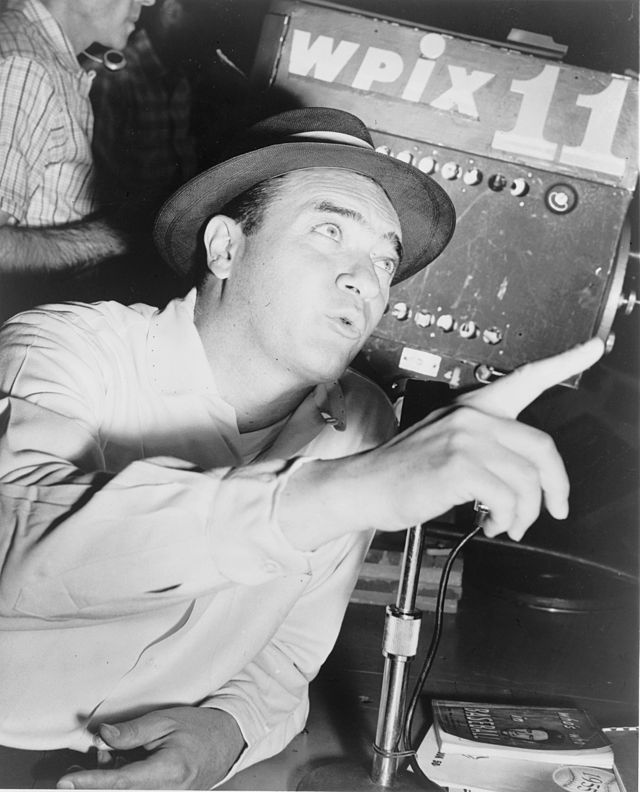
Mel Allen
Mel Allen was The Voice:
“his boom box of a voice” – Curt Smith
“that wonderful, unmistakable voice” – Dick Young
“the venerable Voice of Summer” – Sports Illustrated
He was the voice of the Yankees from 1939 through 1964 and became the most prominent sports broadcaster in America. His credits include twenty World Series, twenty-four All-Star Games, fourteen Rose Bowls, five Orange Bowls and two Sugar Bowls. During his prime years, it seemed that Allen was on the air for every major sports event; the presence of The Voice signified that the game was a major event.
He was born Melvin Israel in Birmingham, Alabama, on St. Valentine’s Day, 1913, the first of three children of Russian immigrants Julius and Anna (Leibowitz) Israel. (The family was living in Johns, Alabama, but the nearest hospital was in Birmingham.) Julius sold dry goods in several small Southern towns before settling his family in Tuscaloosa, Alabama.
Allen told broadcast historian Curt Smith he got his first exposure to baseball while sitting in an outhouse looking at pictures of bats and gloves in catalogs from Sears or Montgomery Ward. He saw his first Major League games when he visited an aunt in Detroit; Babe Ruth hit a home run in one of them.
Melvin advanced quickly through small-town schools and entered the University of Alabama at the age of fifteen. He tried out for football, but didn’t make the team; instead, he became an equipment manager.
He also served as public-address announcer for the Crimson Tide’s home games. When a Birmingham radio station asked coach Frank Thomas to recommend a play-by-play announcer, Thomas—apparently figuring play-by-play was just like PA announcing—named Melvin Israel. His radio career began on station WBRC in 1935. In addition to doing play-by-play for the Tide, Israel received both an undergraduate degree and a law degree from Alabama and passed the bar exam.
On vacation in New York in 1937, he auditioned for the CBS radio network. In later years he made it seem like a lark, as if he had just wandered in off the street. In fact, his Alabama football broadcasts had been noticed by Ted Husing, CBS’s top sports announcer, and by the entertainment newspaper Variety. Whether it was lark or design, he was offered a job at $45 a week.
Mel’s father was not pleased, thinking his son was wasting a good education. He was even less pleased when Melvin explained that CBS wanted to change his “Jewish” surname. Trying to placate his father, Mel took Julius’s middle name as his new last name. At CBS Allen announced variety shows starring Perry Como, Jo Stafford, and Harry James. He interrupted Kate Smith’s afternoon program with a news bulletin reporting the crash of the airship Hindenburg. He worked some college football games.
Allen particularly impressed his bosses with a long ad-lib description of the Vanderbilt Cup yacht race, broadcasting from an airplane overhead. That led to his first baseball assignment, as a color commentator on the 1938 World Series. (In those days there was no exclusive Series broadcast; all the major networks carried the games.)
When Allen arrived in New York, the Yankees, Giants, and Dodgers were the last holdouts against radio. Since all the other teams were broadcasting some of their games, the fear that radio would hurt attendance had been buried. But at least one of the New York clubs was always at home, so the teams agreed to a blackout to avoid competing with each other. Opening Day games were broadcast, along with an occasional important series. Local stations re-created highlights of some afternoon games in the evenings, and the Yankees permitted a New York station to carry the night games of their farm team in nearby Newark, New Jersey.
In 1938 the pioneering executive Larry MacPhail became general manager at Brooklyn. He notified the other teams that the Dodgers were going on the air in 1939, and he brought Red Barber from Cincinnati to handle the broadcasts. The Yankees and Giants decided to broadcast their home games, since they never played at home on the same day. Arch McDonald, an established play-by-play man in Washington, was hired as the principal announcer for both teams.
Wheaties, baseball’s primary sponsor, chose Allen to replace McDonald on the Washington Senators’ broadcasts. But Washington owner Clark Griffith signed his former pitcher, the Hall of Famer Walter Johnson, to go behind the mike, so Allen never became the voice of the Senators.
McDonald’s assistant, Garnett Marks, didn’t last long. He wasn’t fired when he delivered a commercial for Ivory Soap, and the words came out “Ovary Soap.” But when he did it again, he was gone. Allen replaced him in June.
Arch McDonald didn’t last long, either. His down-home style—low-key, with long pauses between pitches—didn’t play in New York. After one season he returned to Washington.
In 1940 Allen began his reign as Voice of the Yankees. He continued doing only home games of the Yanks and Giants. Allen often told of an encounter with Lou Gehrig during that season, when Gehrig was dying of the disease that now bears his name. On a rare visit to the Stadium, the Yankee legend said, “Mel, I never got a chance to listen to your games before because I was playing every day. But I want you to know they’re the only thing that keeps me going.” Allen said he left the dugout in tears.
The Yankees and Giants couldn’t find a sponsor for their broadcasts in 1941, so the teams were off the air. Accordingly, Allen never got a chance to chronicle Joe DiMaggio’s fifty-six-game hitting streak, although he later recorded a re-creation of the end of the streak.
Allen entered the Army in 1943 and was stationed at Fort Benning, Georgia. According to the Library of American Broadcasting at the University of Maryland, Sergeant Allen kept his hand in by calling a few Alabama football games while in the service.
When Allen was discharged early in 1946, both the Giants and Yankees wanted him, but the Yankees had an edge. MacPhail had taken over the Yankees by then, with co-owners Dan Topping and Del Webb. He announced another innovation: Yankees broadcasters would travel with the team. Until then, road games were re-created in a studio from a telegraphed play-by-play summary. Allen went with the Yankees. (Barber said MacPhail had offered him the Yankees’ job but he chose to stay in Brooklyn, where he was a civic institution.)
It was a marriage of The Voice and The Dynasty. Beginning in 1947, the Yanks played in fifteen of the next eighteen World Series. Broadcasters from the two league champions customarily handled network coverage of the Series, so Allen claimed the fall classic as his own stage.
His signature phrases entered the American language: A home run was “going, going, gone!” He punctuated any remarkable play with “How about that?” Although he is often credited with coining Joe DiMaggio’s nickname, the Yankee Clipper, David Halberstam says Arch McDonald deserves credit for that. Allen was the first to call DiMag Joltin’ Joe. He labeled Tommy Henrich Ol’ Reliable.
Allen’s style was exuberant; his rich voice conveyed excitement. He was constantly compared with Red Barber—
inevitably, they became the first broadcasters honored by the Baseball Hall of Fame in 1978. Curt Smith described them this way: “The Ol’ Redhead was white wine, cr?pes suzette and bluegrass music; Mel, beer, hot dogs, and the United States Marine Band.” Jim Woods, who worked with both men, said, “One was a machine gun, the other a violin.” Nobody who heard them would have any difficulty discerning which was which.
In radio days a team’s principal broadcaster—usually hired by the sponsors—ruled the booth. He assigned innings to his assistants, decided who would read the commercials and parceled out pregame and postgame duties. Several of Allen’s assistants agreed with Curt Gowdy’s assessment: “It wasn’t very easy to work for him, but when it was all over, you were glad you did.” Gowdy and Jim Woods said they learned from his polish and professionalism but chafed under his high-handedness. As Woods put it, “Whatever Allen wanted, Allen got.”
Red Barber joined the Yankees’ broadcast team in 1954, after leaving Brooklyn over a dispute with owner Walter O’Malley. It was quite a comedown for a man who had commanded his own booth as principal broadcaster for twenty seasons. At first Barber worked only televised home games, handling pregame and postgame shows and two and one-half innings of play-by-play on TV.
Barber insisted in his autobiography that there was no friction between this pair of giant egos—”Mel accepted me as an equal”—but others said their relationship was cool. They were opposites: Barber was married, a homebody who disliked traveling, and a devout Christian; Allen, single, gregarious, a man-about-town, and a Jew. Barber’s career was going downhill; Allen was king of the hill. According to Jim Woods, who was dumped from the Yankees broadcasts in 1957 to make room for former shortstop Phil Rizzuto, Allen and Barber were united in their mutual loathing of the jock-in-the-booth. Allen and Barber resolved their differences enough that Allen, nearly eighty years old, traveled from New York to Florida in 1992 to attend Barber’s funeral.
Allen’s fame grew as television replaced radio as the primary mass entertainment. He switched to TV coverage of the World Series in 1951, the first time the Series was televised coast-to-coast.
Like most radio broadcasters who attempted that transition, Allen never fully mastered the new medium. Echoing a common complaint, Ben Gross of the New York Daily News wrote in 1954 that Mel “has frequently been castigated for talking too much during his baseball telecasts. Like so many others, he often seems unwilling to permit the camera to tell the story and, at times, attempts to gild the picture on the tube with excessive verbiage.”
Some accounts say Allen was the first to suggest the center-field camera shot that is now standard on baseball telecasts. Yankees General Manager George Weiss limited the use of the shot for fear that opposing teams, watching TV, would steal the catcher’s signs.
Since Allen was the Voice of the Yankees, he was accused of partisanship on the Series broadcasts. Allen acknowledged he was partisan, but also declared, “I never rooted.”
He was renowned, too, as a skillful pitchman for the sponsors. A home run was “a Ballantine blast,” after the beer sponsor, or “a White Owl wallop,” after the cigar sponsor. In addition to his work on network college-football broadcasts, Allen was the sports voice of Movietone newsreels and hosted boxing matches.
Allen moved his parents, brother, and sister to the New York area and continued living with his sister after their parents died. His brother, Larry, who also adopted the name Allen, became his statistician and assistant.
Allen was six-foot-one, slim, and dark-haired in his youth, but began balding at an early age. By the 1950s he usually wore a hat during his TV broadcasts. He never married, but was often seen in the company of beautiful Broadway showgirls. Red Barber wrote in The Broadcasters, “His job was his life … the wife and children he never had.”
“I never saw anyone love his work more than he did,” said Lindsey Nelson, a prominent football broadcaster of the 1950s and later the voice of the New York Mets.
In the fourth game of the 1963 World Series, the Dodgers were on their way to an unprecedented sweep of the Yankees. In midgame, Allen was suddenly unable to speak. He blamed a flareup of a “nasal condition,” but many commentators said he was struck speechless by the Yanks’ humiliation. Sportswriter Dick Young called it “psychosomatic laryngitis.”
As the 1964 season ended, Allen’s world came crashing down. The Yankees’ president, Dan Topping, summarily fired him. Rizzuto represented the team on World Series telecasts. Joe Garagiola replaced Allen on the 1965 broadcasts.
The Yankees never explained his dismissal, so the rumor mill percolated. “They said I was a lush or that I beat my relatives or that I’d had a breakdown or that I was taking so many medicines for my voice that I turned numb,” he told Curt Smith years later. None of the rumors appeared in print, so Allen never publicly denied them. He said Topping gave him no explanation, saying only, “It wasn’t anything you did, Mel, and it wasn’t CBS.” CBS had just bought the team; as soon as Allen was gone, the network brought in one of its executives to supervise the Yankee broadcasts. There would be no more principal broadcaster. Allen believed the Yankees’ primary sponsor, Ballantine Beer, wanted to shed his high salary.
Topping told Red Barber, “I’m tired of him popping off.” But Allen said, “If they had objected to my talking a lot, I’d have been fired long ago.” Larger issues were at play; Ballantine beer was losing market share and the Yankees, despite winning the 1964 pennant, had drawn fewer fans than the last-place Mets. CBS wanted to promote a new, friendlier image for the regal Bronx Bombers.
The true story of Allen’s sudden fall from the pinnacle remains a mystery. “He gave the Yankees his life,” Barber said, “and they broke his heart.” Adding insult to injury, NBC dropped him from its college football telecasts.
Only fifty-one years old, he wasn’t out of work for long. The Braves played their final season in Milwaukee in 1965, held hostage by a court order although they had already announced that they intended to move to Atlanta. An Atlanta TV station hired Mel to broadcast some of the team’s games to their soon-to-be home.
Allen and Atlanta seemed a natural match: the biggest of big league voices for the new big league city, and a Southerner, to boot. But he didn’t join the Braves in Atlanta. In 1968 he went to Cleveland to televise Indians’ games. During one dull evening in a losing season, he stunned his broadcast partner–and, no doubt, the audience–by reciting Longfellow’s “Song of Hiawatha.” He turned down an offer to broadcast the Athletics’ games when they moved to Oakland. Allen said his business interests, including a Canada Dry soft-drink dealership, kept him on the East Coast, but his sister, Esther Kaufman, told biographer Stephen Borelli he would not leave New York because that would be admitting defeat.
Allen made public appearances for Canada Dry, broadcast University of Miami football, and hosted local and network radio sports shows. One of his few baseball assignments was the 1966 Little League World Series for a Sacramento radio station. While other broadcasters routinely jumped from team to team, Allen vanished from big-time sports for eight years. “It was as if he had leprosy,” Sports Illustrated’s William Taafe wrote in a 1985 profile.
Allen returned to Yankee Stadium on June 8, 1969, to serve as master of ceremonies on Mickey Mantle Day. In 1976 WPIX, the Yankees’ flagship TV station, hired him to narrate a special program celebrating the opening of the refurbished Yankee Stadium.
By then CBS and Dan Topping were long gone; George Steinbrenner owned the franchise. When Steinbrenner was a young assistant football coach, he had sought Allen’s advice about getting into broadcasting and Allen spent forty-five minutes with him. Steinbrenner never forgot that kindness. On Opening Day in the new-old stadium, the Yankees recognized Allen’s place in their history. He stood on the field during pregame ceremonies alongside other symbols of the Yankee legacy: Bob Shawkey, who had thrown the first pitch in the Stadium in 1923; Pete Sheehy, the clubhouse manager since 1927; restaurant owner Toots Shor; and former Postmaster General James Farley, who was said to be “the longest-running season-ticket holder.”
The next year Allen was back on Yankee broadcasts, calling a few dozen games for the SportsChannel cable network. He continued in that role until 1985. Beginning in 1977, Allen said, “How about that?” to a new generation of fans across the country as narrator of Major League Baseball’s weekly highlight show, This Week in Baseball (known as TWIB). Joe Reichler, a former sportswriter working in the commissioner’s office, gave him the job. He was the program’s signature voice even after his death: TWIB created an animated figure, complete with microphone and fedora, to introduce each week’s show with his trademark greeting, “Hello, everybody. This is Mel Allen.”
In 1978 the Baseball Hall of Fame established the Ford C. Frick Award to honor broadcasters for “major contributions to baseball.” Allen and Barber were the first to be recognized. (Broadcasters are not considered members of the Hall of Fame; there is no “broadcasters’ wing,” either. The winners are honored in an exhibit near the Hall’s library.)
Marty Appel, a former Yankees publicist who was producing the team’s broadcasts on WPIX, brought Allen back one last time in 1990 so he could be the answer to a trivia question: the first man to broadcast a major league game in seven decades. His Yankee career stretched from Lou Gehrig to Don Mattingly.
Allen died on June 16, 1996, at his home in Greenwich, Connecticut. He had suffered from heart trouble for years. He was buried in Temple Beth El Cemetery in Stamford, Connecticut. His gravestone reads: “Mel Allen Beloved son brother – uncle.” More than a thousand people attended a memorial service in New York’s St. Patrick’s Cathedral sponsored by the Committee for Christian-Jewish Understanding. On July 25, 1998, a plaque commemorating his career was unveiled in Monument Park at Yankee Stadium.
Only two sports broadcasters have equaled Mel Allen’s fame: the pioneer radio announcer Graham McNamee and Howard Cosell, the man so many fans loved to hate. Like Allen, both dominated the big events of their time. In Allen’s time, more than half of the television sets in the United States would be tuned in to the World Series. There were just three national TV networks – ABC, CBS, and NBC – and no regional sports networks.
With fewer games on television and fewer sports competing for attention, the leading broadcasters – Allen on baseball, Lindsey Nelson on college football – were the voices and faces of American sports. As Allen acknowledged, his renown was partly an accident of time and place: in New York, when the Yankees were giants. His success was also a product of his unique, vibrant voice and the craftsmanship and showmanship that he achieved by hard work.
Later generations of broadcasters—Gowdy, Brent Musberger, and Joe Buck—enjoyed similar wide exposure on showcase events. None was ever called The Voice.
Sources
Appel, Marty. Now Pitching for the Yankees. Toronto: Sport Classic Books, 2001.
Barber, Red. The Broadcasters. New York: The Dial Press, 1970.
Barber, Red, and Robert Creamer. Rhubarb in the Catbird Seat. Garden City, New York: Doubleday and Company, 1968.
Borelli, Stephen. How About That! The Life of Mel Allen. Champaign, IL: Sports Publishing, 2005.
Gross, Ben. I Looked and I Listened. New York: Random House, 1954.
Halberstam, David. Summer of ’49. New York: William Morrow and Company, 1989.
Halberstam, David J. Sports on New York Radio: A Play-by-Play History. Lincolnwood, Illinois: Masters Press, 1999.
Patterson, Ted. The Golden Voices of Baseball. Champaign, Illinois: Sports Publishing LLC, 2002.
Smith, Curt. The Storytellers. New York: Macmillan, 1995.
_________. Voices of the Game. South Bend, Indiana: Diamond Communications, 1987.
(Author unknown), Mel Allen obituary, The Associated Press, June 16, 1996. Hoffman, Roy. “The Late Mel Allen: Alabama’s Voice of the Yankees.” Mobile Register, July 6, 2003. Smith, Curt, “Buck known for effortless style, class.”
Websites
www.espn.com, June 21, 2002.
www.americansportscasters.com
www.anecdotage.com
Full Name
Melvin Allen
Born
February 14, 1913 at Birmingham, AL (US)
Died
June 16, 1996 at Greenwich, CT (US)
If you can help us improve this player’s biography, contact us.